Built with the people who try the cases.
The chronology is the problem
Eight hundred rows. Thirty providers. Four years of treatment flattened into a spreadsheet that answers almost none of the questions you actually need answered. When did treatment stop, and did it start again. What was this person like before the crash. Which six dates out of six hundred does an adjuster need to see to understand what happened here.
So it gets done by hand. A paralegal spends two days building a timeline in slides, and it's stale the week new records arrive.
Verdate takes the chronology your team already produces and turns it into a timeline you can work from: filter it, group it by provider or body part, mark the incident, flag the dates that matter, click an event and open the source page it came from. One view for a jury, another for walking a client through their own case, another for a demand package.
Our mission
We didn't invent the feature list
Verdate's requirements weren't written by engineers guessing at how a personal injury practice works. They came from a room of practicing trial attorneys who were asked, directly, what they needed from a treatment timeline, working against a real firm's real case files.
What they asked for reads nothing like what a product team would have specified on its own. Mark the crash on the timeline, because it isn't in the chronology. Show me before and after. Flag the dates that carry the case: the surgery, the MRI, the day treatment stopped. Group by provider, by body part, by medication type. Let me click an event and open the source page it came from. Let me rewrite a summary in my own words. Let me ask when the first MRI was, or how many PT sessions there were, and cite the answer back to the record.
That list is the product. And when there was something to use, those same attorneys used it themselves rather than sitting through a demo of it. One of them wanted a marker for where treatment ended, and whether it ended because the client was discharged or because they quit going. It was in the product three hours later. What they said in that room, about what worked and what didn't, is what the current version was built from.
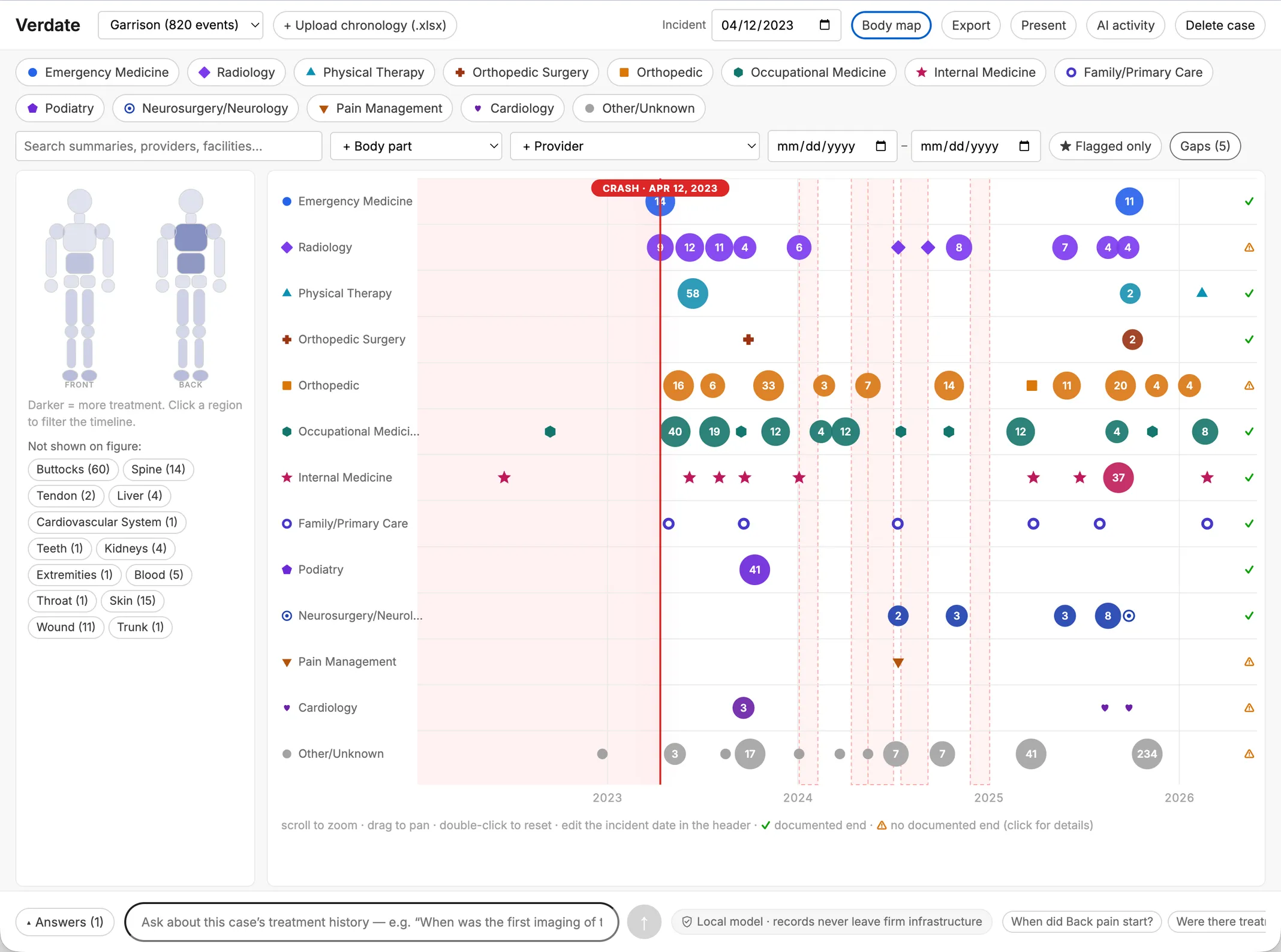
- 800+
- events in the sample case
- 30+
- providers on a single timeline
- 0
- outbound network connections
- 1
- product, built for one kind of firm
Why it runs on your hardware
Every other AI product in this category asks the same thing of you. Upload your client's medical records to a server you don't control, operated by a company you have no engagement with, so a model can read them. The reassurance offered is a policy document and a logo.
We think that's the wrong trade for privileged material, so we built the other thing.
Verdate runs on an appliance that sits in your office. The model is open-weight and runs on that box. Your records are read by hardware you can point at. And the on-premise product makes no outbound network connections at all: no analytics, no telemetry, no crash reporting, no update pings, no license checks, no remote fonts. That isn't a policy commitment, it's enforced in the build. Pull the ethernet cable out of the appliance and everything still works. That's the demonstration we'd rather give you than any slide about security posture.
The point isn't only what it protects. It's what it makes possible. Once client material doesn't have to leave the building, work opens up that no firm can put in a cloud tool at any price: comparing a case against your own history for valuation, working from your own deposition transcripts. Confidentiality is the floor here, not the pitch.
What we don't let the model do
Counts, dates, gaps, and first mentions are computed in code. They're never generated. If Verdate tells you there were forty-one PT sessions and a seven-month gap in 2020, that's arithmetic, and you can check it against the records. The model handles language: summarizing an encounter, rephrasing a summary in plain English for a jury, answering a question with a citation back to the page it came from. Anything a model extracts is held behind attorney verification before it renders on a timeline you'd put in front of anyone.
We'd rather ship a narrower product you can rely on than a broader one you have to audit.
Who builds it
Verdate is built by Relay Spatial, Unipessoal Lda., a company registered in Portugal. Small on purpose. We build one product, for one kind of firm, and the roadmap keeps coming from the same place the first version did: attorneys telling us what's missing.
We build in Portugal and sell to firms in the United States. That matters less here than it would for other software, because of how this one is built: there is no server of ours with your client's records on it, and no copy of your case file in our possession. There's no vendor jurisdiction question because there's no vendor copy.
Verdate is new. It's been built and tested against real case files, including one running past eight hundred events, and it's now going in front of firms for evaluation. If you want to be one of the first, start with the demo.
See it on a real chronology
The demo runs on a sample case of more than eight hundred events. Nothing to upload, nothing to install, seven days.