Step 1
You already have the chronology.
However your firm produces it, in-house or through a vendor, the spreadsheet of dated encounters is the input. Verdate doesn't replace that step.
Verdate starts where your chronology ends. No new intake process, no change to how your team builds records, no records for us to hold.
The flow
Step 1
However your firm produces it, in-house or through a vendor, the spreadsheet of dated encounters is the input. Verdate doesn't replace that step.
Step 2
Encounters, providers, facilities, body parts, medication types, summaries, and links to the source pages come across as they are.
Step 3
Set the incident date. Flag the surgery, the MRI, the day treatment stopped. Add milestones the records don't contain, because the crash isn't in the chronology.
Step 4
Group by provider, body part, or medication type. Filter by date, keyword, or provider. Treatment gaps and first mentions surface on their own. Click any event to open the source page behind it.
Step 5
A compact view for an exhibit, a detailed view for a client conversation, a presentation mode for the room, exports for the file.
Up close
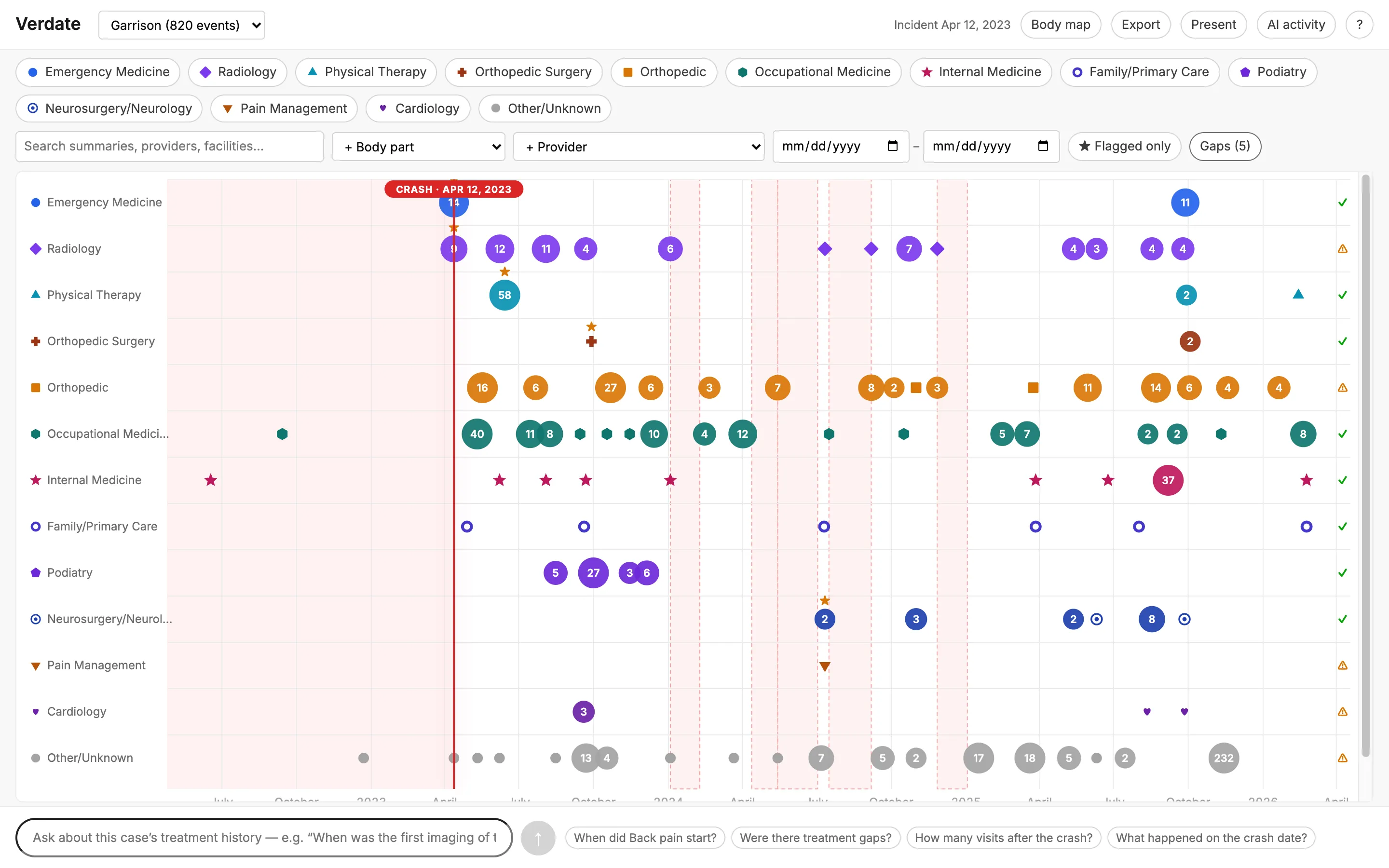
Every screen below is the live demo on a fabricated sample case of 820 events. No real records appear anywhere on this site.
01
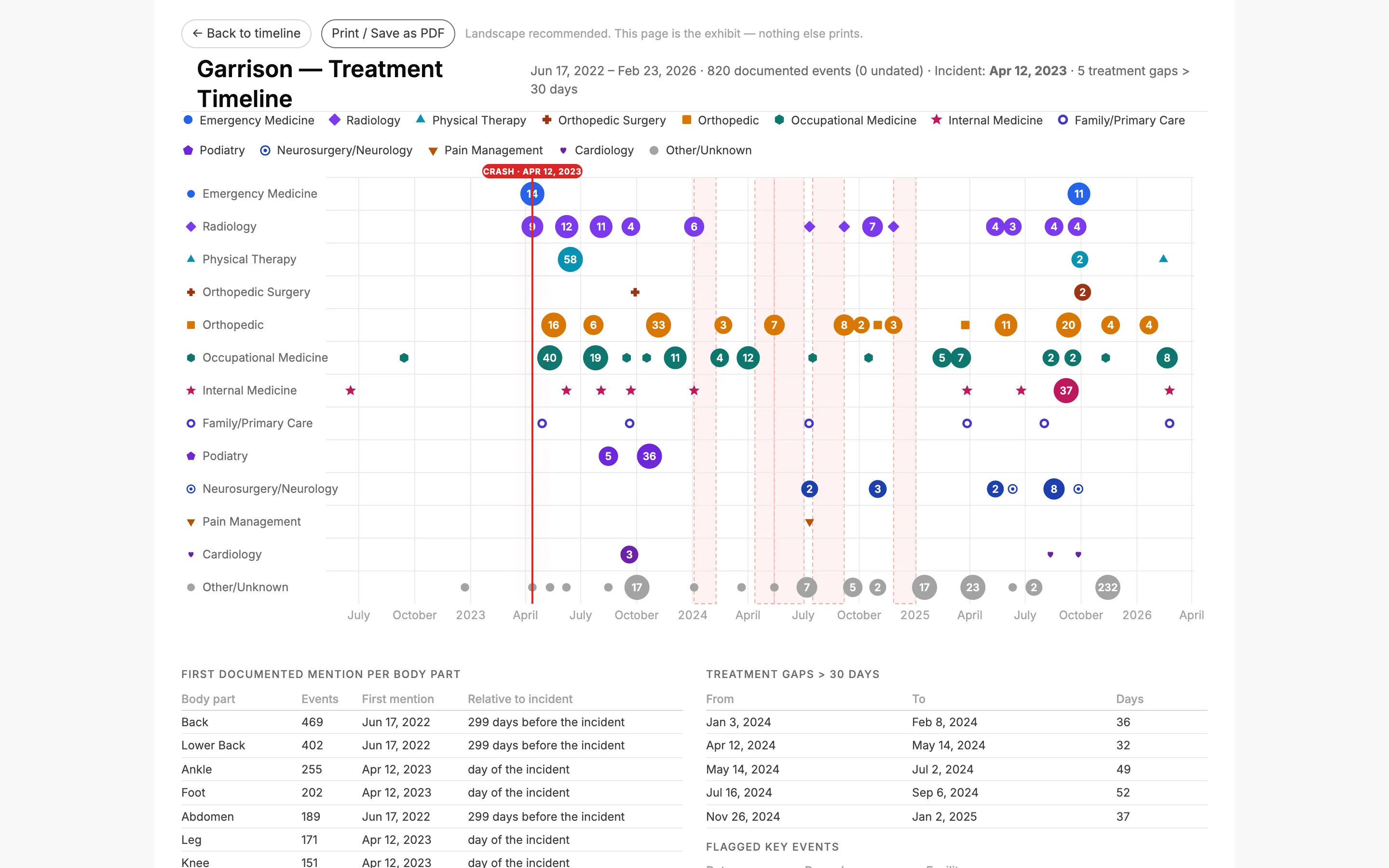
The whole chronology on one screen. Rows group events by medicine type, so the shape of treatment is visible at a glance.
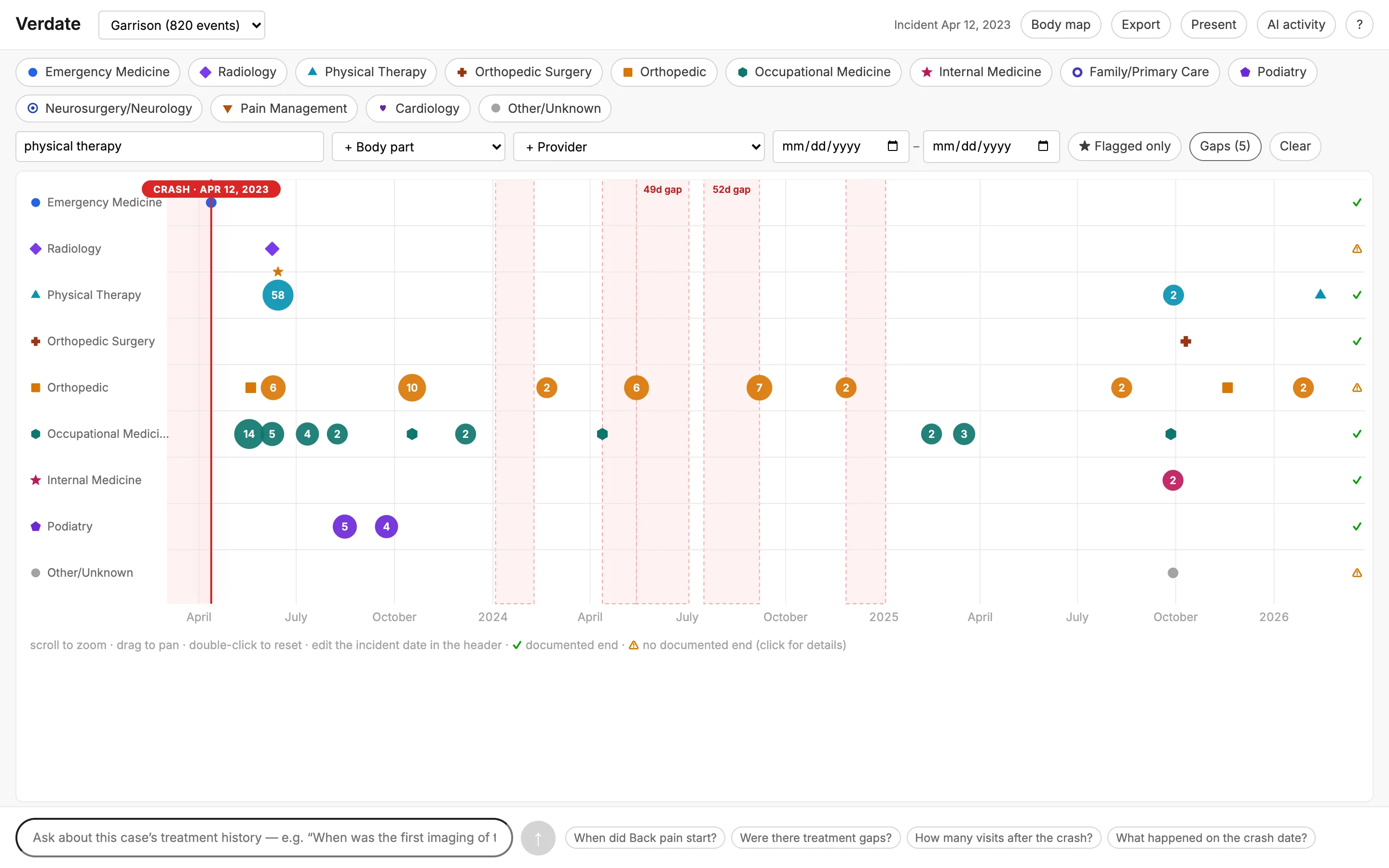
02
Filter by specialty, body part, provider, date range, or free-text search. Combinations stack, and the timeline updates as you go.
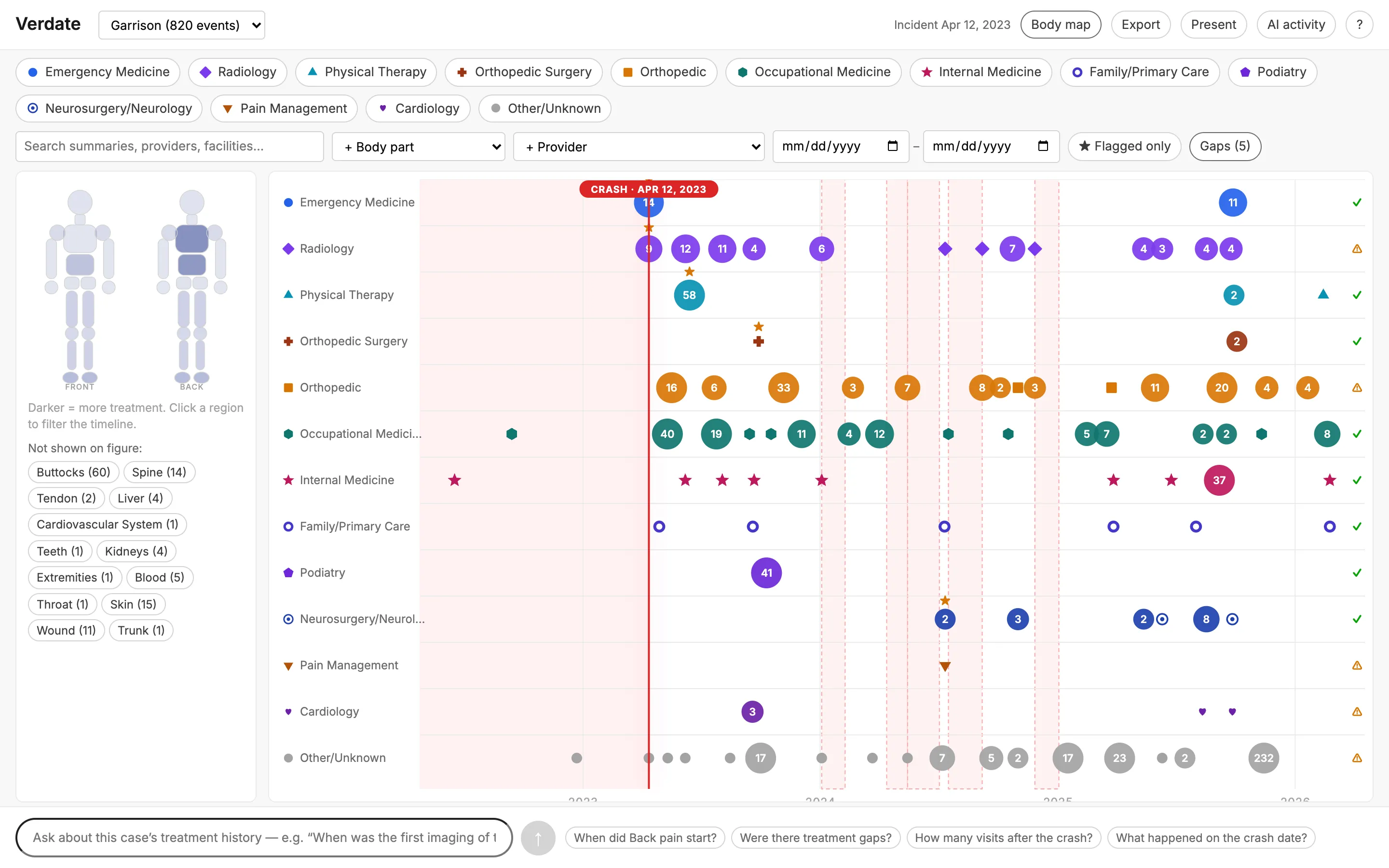
03
Injury locations drawn on a body diagram, linked to the events that mention them.
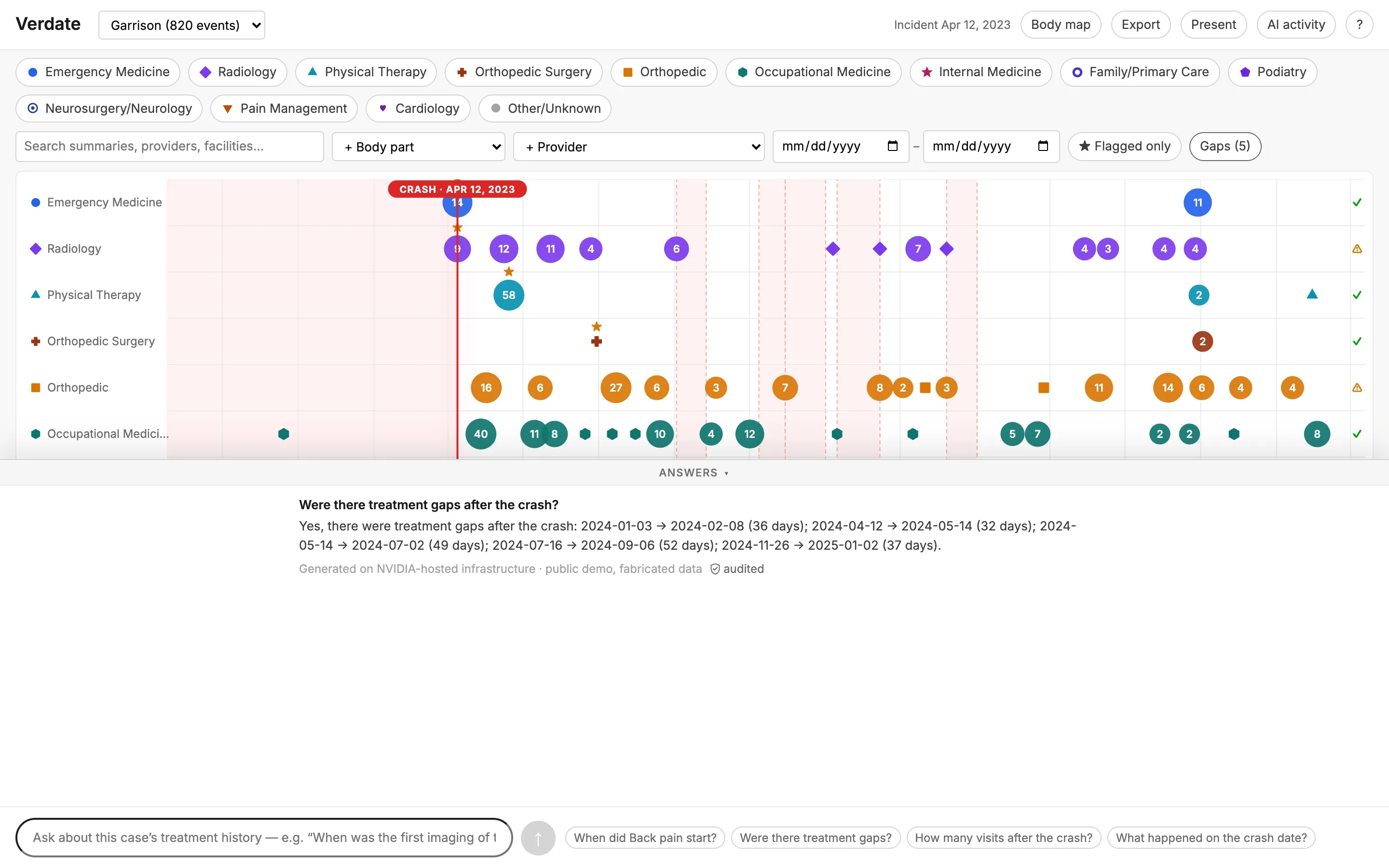
04
Ask questions about the treatment history in plain English. Counts, dates, and gaps are computed in code, not generated, and every answer cites the events it relies on.
05
Flag the dates that carry the case and Present walks them one screen at a time: the crash-day ER visit, the imaging, the surgery.
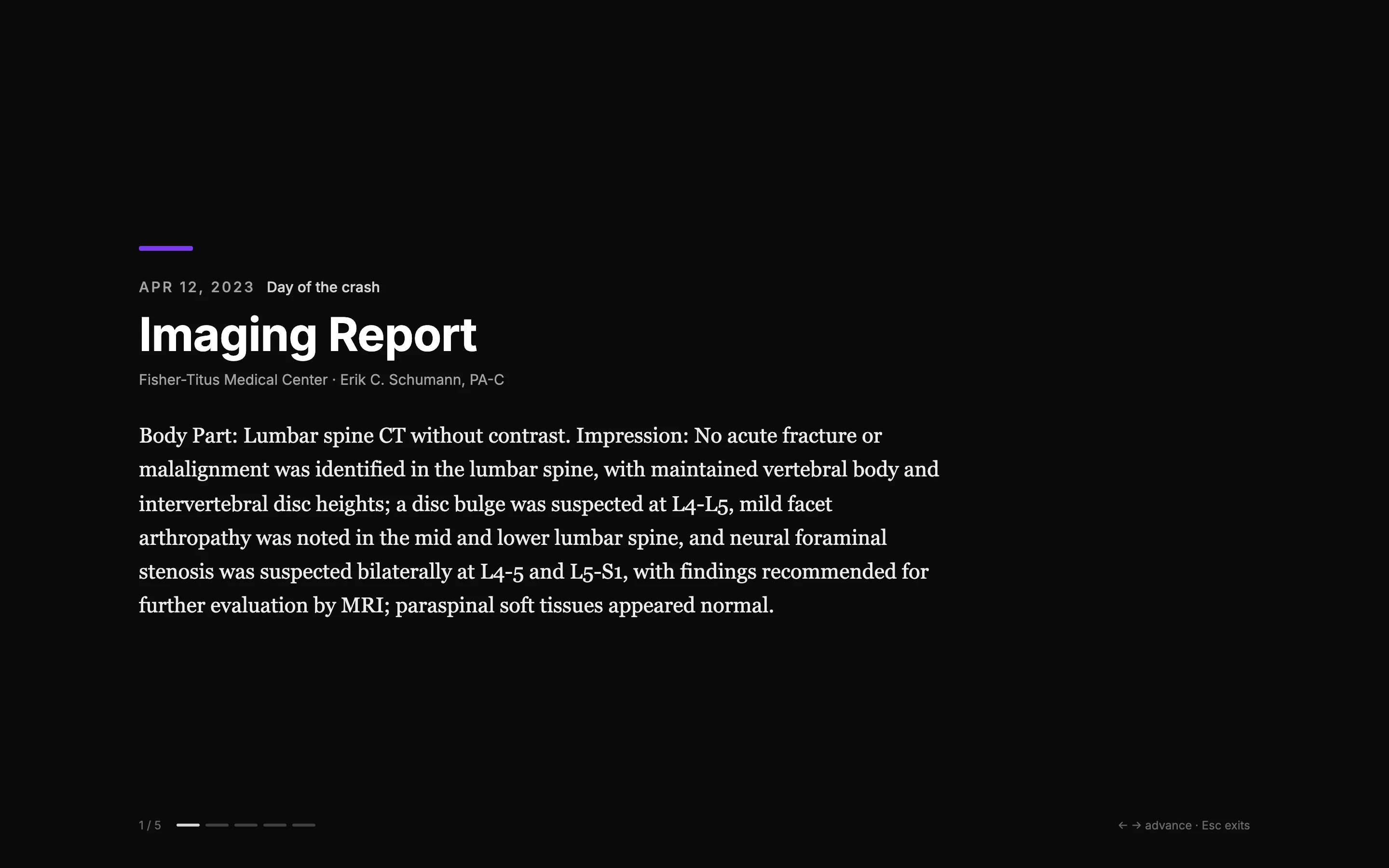
06
A compact view for a slide, a detailed view for the demand package.
This is the part most legal AI gets backwards, so it's worth being specific about.
The model runs on an appliance in your office. Not a private cloud, not a dedicated tenant, not a region. A box, on your network, that you can point at.
The on-premise product makes no outbound network connections of any kind. No analytics. No telemetry. No crash reporting. No update pings, no license checks, no remote fonts, no CDN assets. That isn't a policy we've written down, it's enforced in the build: any attempted outbound connection fails our pipeline before a release exists.
Which means the claim is checkable rather than promised. Unplug the appliance from the internet and everything still works. We'll document the verification procedure so your IT can confirm it without taking our word for anything.
Updates are pulled by the appliance from a signed registry. Nothing is ever pushed into your network from outside it.
The reason this matters beyond privilege: once client material doesn't have to leave the building, work becomes possible that no firm could put in a cloud tool at any price. Comparing a case against your own history. Working from your own deposition transcripts. Confidentiality is the floor, not the ceiling.
Counts, dates, treatment gaps, and first mentions are computed in code. They're never generated, so they're checkable against the records.
The model handles language. Summarizing an encounter. Rephrasing a summary in plain English for a jury, or in your own words if you'd rather write it yourself. Answering a question, with a citation back to the page the answer came from.
Anything the model extracts is held behind attorney verification before it renders on a timeline you'd put in front of anyone. You approve it, or it doesn't appear.
The trial demo runs on our servers, not yours, on synthetic case data. That's the opposite of how the product works, and we'd rather say so plainly than have you find it in devtools. It exists so you can see the thing without waiting for hardware. The on-premise product is the product.
How you get it
Pilot
Hosted on private infrastructure, single tenant, no hardware to install. The fastest way to start.
On-premise
An appliance, leased as part of the subscription. Updates, model refreshes, monitoring, and overnight replacement included. Cancel and the box comes back to us.
Enterprise
Your own infrastructure, supported by us.
Seven days on a chronology of more than eight hundred events. No install, no upload, no hardware.